
The Town is proposing a 42 kilowatt solar array on Town property at 216 Beech Hill Road (the old sand/salt shed). The proposed array would not block access to the sand shed; residents would still be able to get winter sand from the shed.
The Town held a Special Town Meeting on Wednesday, January 21, 2026, at 6pm, at the Edna Drinkwater School, to vote on the proposal. The warrant is available here. Sixty-one voters attended, and the vote in support was unanimous. Bangor Daily News coverage of the project is available here.
Please contact James Kossuth at administrator@northportmaine.org or 338-3819×6 to learn how you can help on this and other town fundraising projects.
Here are some frequently asked questions about the project —
Where would the panels be located?
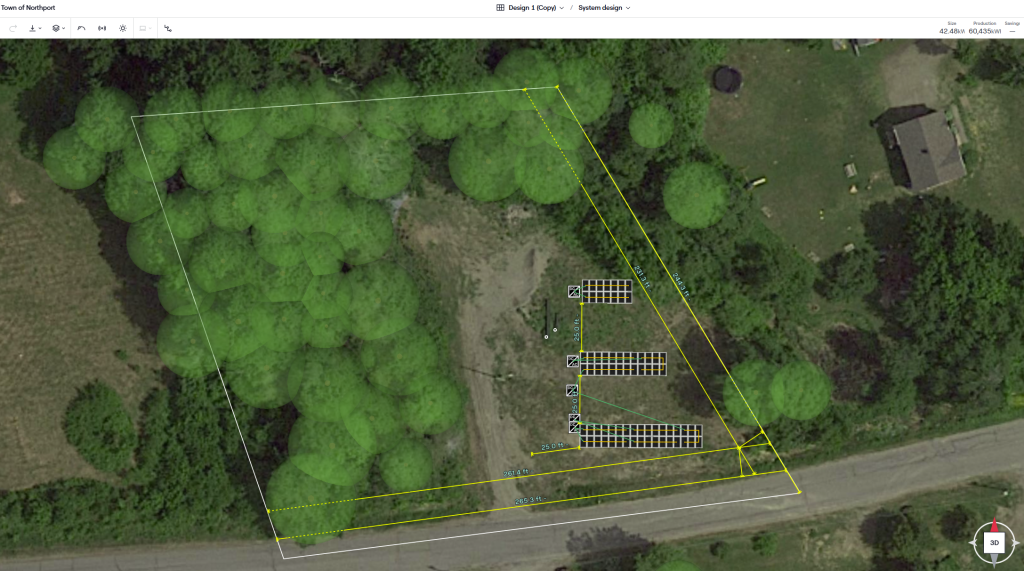
72 ground-based panels would be in front of the old sand/salt shed on the Town’s 1.2-acre lot at 216 Beech Hill Rd.
What will the installation look like?
The installation will consist of three rows of panels, facing Beech Hill Road, and to the right of the driveway accessing the sand shed, as shown in this diagram:
How would solar panels benefit the Town?
The panels will generate approximately 60,000 kWh/year of electricity, which will fully offset electricity used by the Town’s four CMP accounts each month. Before the new town building is completed, the balance will partially offset electricity for the Drinkwater School. The Town currently pays around $7,000 a year for about 24,000 kWh of electricity for Town accounts, and around $25,000 per year for the School’s CMP account (~150,000 kWh). With the anticipated solar generation, the Town would save around $15,000 per year for electricity over the next 30 years at current rates, and even more as CMP rates continue to increase. The total savings over the expected 30-year lifespan of the panels is $450,000.
How would the installation be paid for?
The panels will cost $117,500 to install. We expect the cost to be covered entirely through contributions and grants. Residents have contributed $10,000 to cover an initial (refundable) deposit. A second installment of $23,500 will be due in mid-March. The Town is applying for grants to pay for the remaining $82,250. Once the panels are installed, we will receive a 30% rebate ($35,250), so the total cost of the array will be around $82,100, all at no additional cost to taxpayers.
Why did plans for a solar array come up so quickly – couldn’t it wait until next year?
To qualify for the 30% federal rebate, the Town had to sign a contract and place an initial deposit by December 31, 2025. Waiting would have cost the Town more. Our contract with Sundog Solar is contingent on voter approval at a Special Town Meeting on Wednesday, January 21, at 6:00 pm at the Drinkwater School. The contract is also contingent on finding funding.
Do solar panels contain toxic materials? When installed, do they present any environmental concerns?
In addition to the major components noted above, panels can contain small amounts of tin, tellurium, antimony, gallium and small amounts of toxic metals like lead and cadmium. The backsheets contain PFAS which can be released if the panels are burned, which is why Maine law requires panels to be recycled when decommissioned. Panel materials are enclosed in a way that prevents any release of toxic materials to the environment. There is no evidence of toxic material leaching out of solar panels. Decommissioned solar panels are not classified as hazardous waste. Panels past their useful life (at least 30 years) must be recycled, and not landfilled or incinerated.
SEIA PV Toxicity Factsheet (pdf): https://seia.org/wp-content/uploads/2025/06/PV-Toxicity-Factsheet_5-2025.pdf
Advanced Power Alliance: https://poweralliance.org/2024/11/16/are-solar-panels-are-filled-with-toxic-chemicals-that-leach-into-our-water-supply/
Can solar panels be recycled?
Maine law requires solar panels to be recycled. Solar panels are made primarily of glass (77%), aluminum (10%), silicon (3%), copper wire, polymer layers, a back sheet, and a plastic junction box. Specialized recycling facilities can recover up to 95% of panel materials. Today’s cost to pick up, transport, and recycle panels is typically around $20-25 per panel. At those rates, 72 panels would cost approximately $1,800 to recycle. (The panels are expected to last at least 30 years.) Some panels qualify for manufacturer take-back programs.
Currently there are dozens of SEIA-certified PV panel recycling collection sites and nine SEIA-certified recycling facilities around the US. The two collection sites nearest to Maine (today) are in Massachusetts. Solar Energy Industries Association (SEIA) approves recycling vendors in the US.
For more information:
What other towns have installed solar panels?
Hope, Monroe, Searsmont, Camden, Lincolnville, Belfast, Boothbay, Waldoboro, Damariscotta, Oakland, Tremont, Bucksport Wastewater Treatment facility…and others.
What are the risks?
In the event we are unable to raise sufficient funding through contributions and grants, we would have to either abandon the project, or borrow funds to cover the portion we are unable to raise. Unspent funds from our initial deposit are refundable.
How long will it take to build and start generating electricity for the Town?
If the Town can raise the money this spring and summer, construction is expected to be complete and the system generating electricity for the Town by the end of September, 2026.
What are the technical specifications of the array?
The contract includes all the technical specifications.